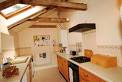
A kitchen is a room or part of a room used for cooking and food preparation
In the West, a modern residential kitchen is typically equipped with a stove, a sink with hot and cold running water, a refrigerator and kitchen cabinets. Many households have amicrowave oven, a dishwasher and other electric appliances. The main function of a kitchen is cooking or preparing food but it may also be used for dining and entertaining.
Antiquity Greece homes of the wealthy had the kitchen as a separate room, usually next to a bathroom (so that both rooms could be heated by the kitchen fire), both rooms being accessible from the court. In such houses, there was often a separate small storage room in the back of the kitchen used for storing food and kitchen utensils.
In the Roman Empire, common folk in cities often had no kitchen of their own; they did their cooking in large public kitchens.
Wealthy Romans had relatively well-equipped kitchens. The kitchen was typically integrated into the main building as a separate room, set apart for practical reasons of smoke and sociological reasons of the kitchen being operated by slaves. The fireplace was typically on the floor, placed at a wall—sometimes raised a little bit—such that one had to kneel to cook. There were no chimneys.
Middle ages the kitchens were divided based on the types of food prepared in them.[1] In place of a chimney, these early buildings had a hole in the roof through which some of the smoke could escape. Besides cooking, the fire also served as a source of heat and light to the single-room building. With the advent of the chimney, the hearth moved from the center of the room to one wall, and the first brick-and-mortar hearths were built. The fire was lit on top of the construction; a vault underneath served to store wood. Pots made of iron, bronze, or copper started to replace the pottery used earlier. The temperature was controlled by hanging the pot higher or lower over the fire, or placing it on a trivet or directly on the hot ashes.
Colonial kitchens became a separate room only later. In the south, where the climate and sociological conditions differed, the kitchen was often relegated to an outhouse, separate from the mansion, for much of the same reasons as in the feudal kitchen in medieval Europe: the kitchen was operated by slaves.
Local builder in Barbican,


